
The General Product Safety Regulation (GPSR, Regulation (EU) 2023/988) established a more rigorous framework for consumer product safety across the European Union. Since December 13, 2024, manufacturers, importers, distributors, and online sellers are required to ensure that product information, safety information, and traceability data are clearly accessible to consumers and market surveillance authorities.
For eMAG sellers, GPSR compliance is not only a documentation matter. It directly affects product labels, responsible person information, safety warnings, traceability data, and platform readiness.
What eMAG Requires Under GPSR
According to eMAG's guidance on GPSR data requirements, sellers may need to provide the following at the product level:
- Manufacturer and responsible person information — name, address, and email of the manufacturer or EU responsible person
- Safety information — ensuring consumers are informed about potential risks associated with the product
- Product documentation — complete documentation with all necessary safety information
- Traceability information — enabling products to be traced back to their source for accountability and safety checks
- Labeling compliance — labels meeting the specific requirements set out in the Regulation
- CE marking — where applicable, confirming compliance with EU safety standards
In other words, GPSR on eMAG is not just about filling in a few platform fields. It requires sellers to systematically organize product identity, responsible party, safety risks, and traceability into a form that is accurate and audit-ready.
The Legal Foundation: EUR-Lex and EU Harmonised Standards
The legal basis behind these requirements can be verified through EUR-Lex, the official online database for EU law and public documents, publishing legislation and the Official Journal of the European Union (OJEU) in all 24 official EU languages. For sellers verifying GPSR obligations and related product safety requirements, EUR-Lex is an authoritative reference.
Many products are also subject to EU harmonised standards developed by European standards bodies such as CEN, CENELEC, and ETSI, whose references may be published in the OJEU. Compliance with applicable harmonised standards can confer a presumption of conformity with the relevant EU rules.
The challenge for eMAG sellers is not finding the regulation text. The harder part is translating legal and technical requirements into accurate, readable, platform-ready product labels — especially when managing multiple SKUs across different product categories.
Why GPSR Labels Are More Complex Than They Appear
A basic non-electrical product may primarily require product identification, manufacturer information, traceability data, and appropriate warnings. An electrical product may additionally need CE marking, EMC, low voltage safety, RoHS, WEEE, or battery regulation information.
For eMAG sellers managing dozens or hundreds of SKUs, manually translating these requirements into label fields, barcodes, QR codes, and multilingual safety content is time-consuming and prone to error. This is the problem Singulabel is designed to solve: turning scattered compliance information into a structured, repeatable GPSR label creation workflow.
How to Create GPSR-Ready Labels with Singulabel
Below is a step-by-step walkthrough of how to use Singulabel by SVNGU to generate structured, GPSR-ready labels for your eMAG products.
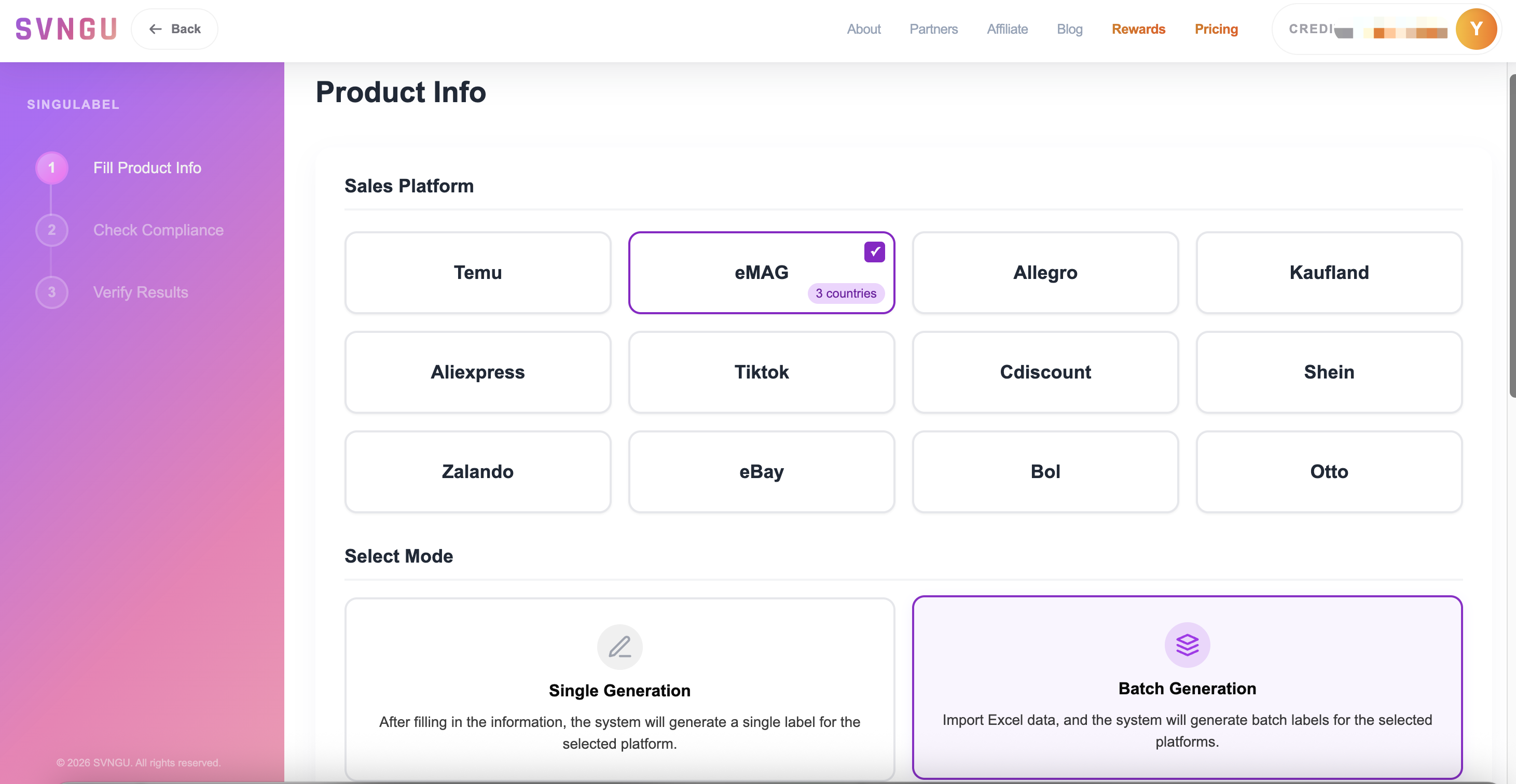
Choose your label generation method
Go to Singulabel under SVNGU and select your GPSR label generation mode. You can choose batch generation — the tool supports up to 100 SKUs and generates labels in approximately 30 seconds.
Fill in product information
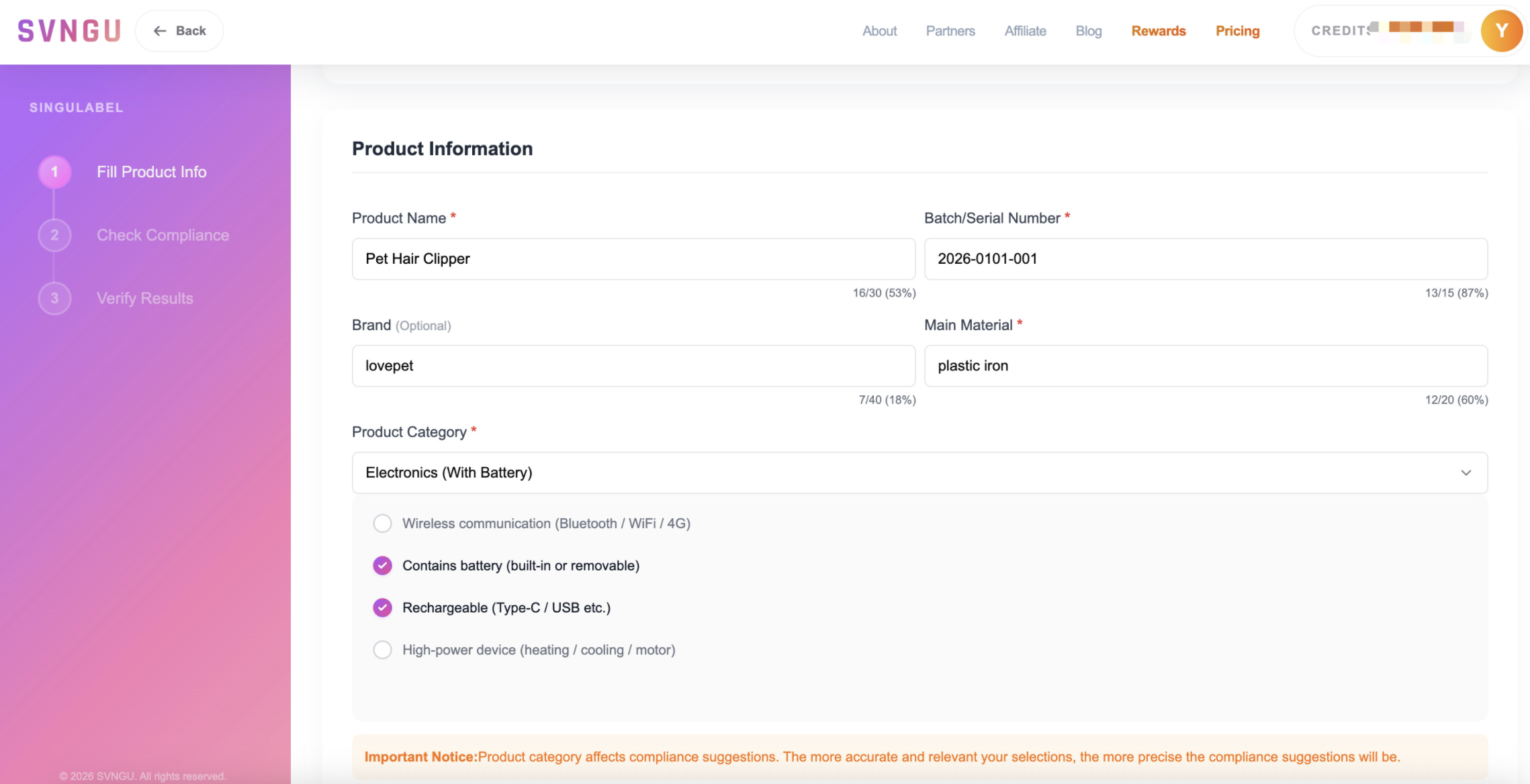
Enter the basic product details: product name, material, category, manufacturer name, and contact information. The more accurately you complete this section, the more targeted the label output will be.
Review compliance references
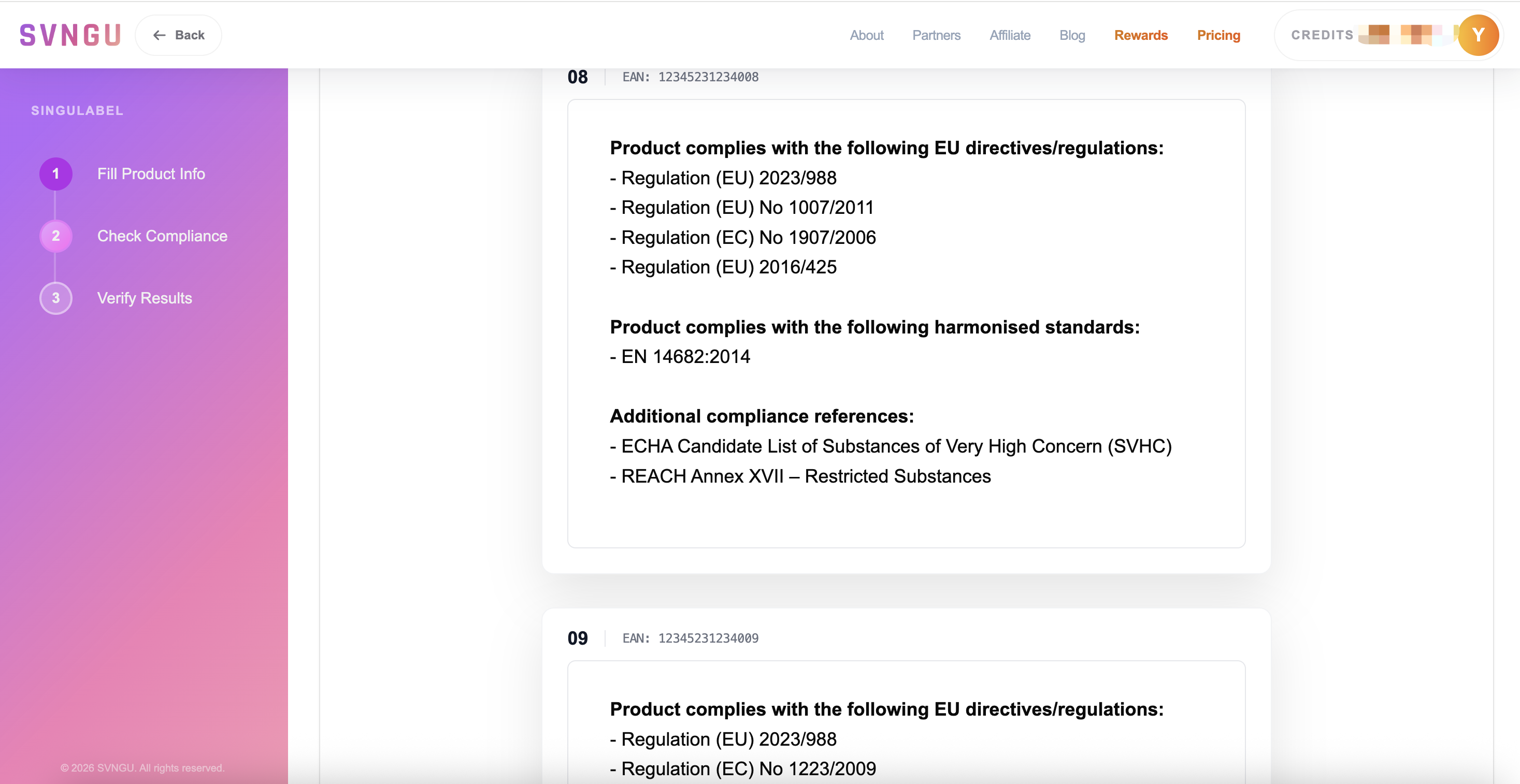
Singulabel references EUR-Lex, the OJEU, and relevant EU harmonised standards to generate targeted compliance content for each product type. The system helps identify applicable regulations, standards, label fields, and safety information relevant to your SKU.
Double-check that the suggested content matches your specific product. Different product categories correspond to different EU regulations and standards — a label for headphones and a label for a baby cup will differ accordingly.
Download your label
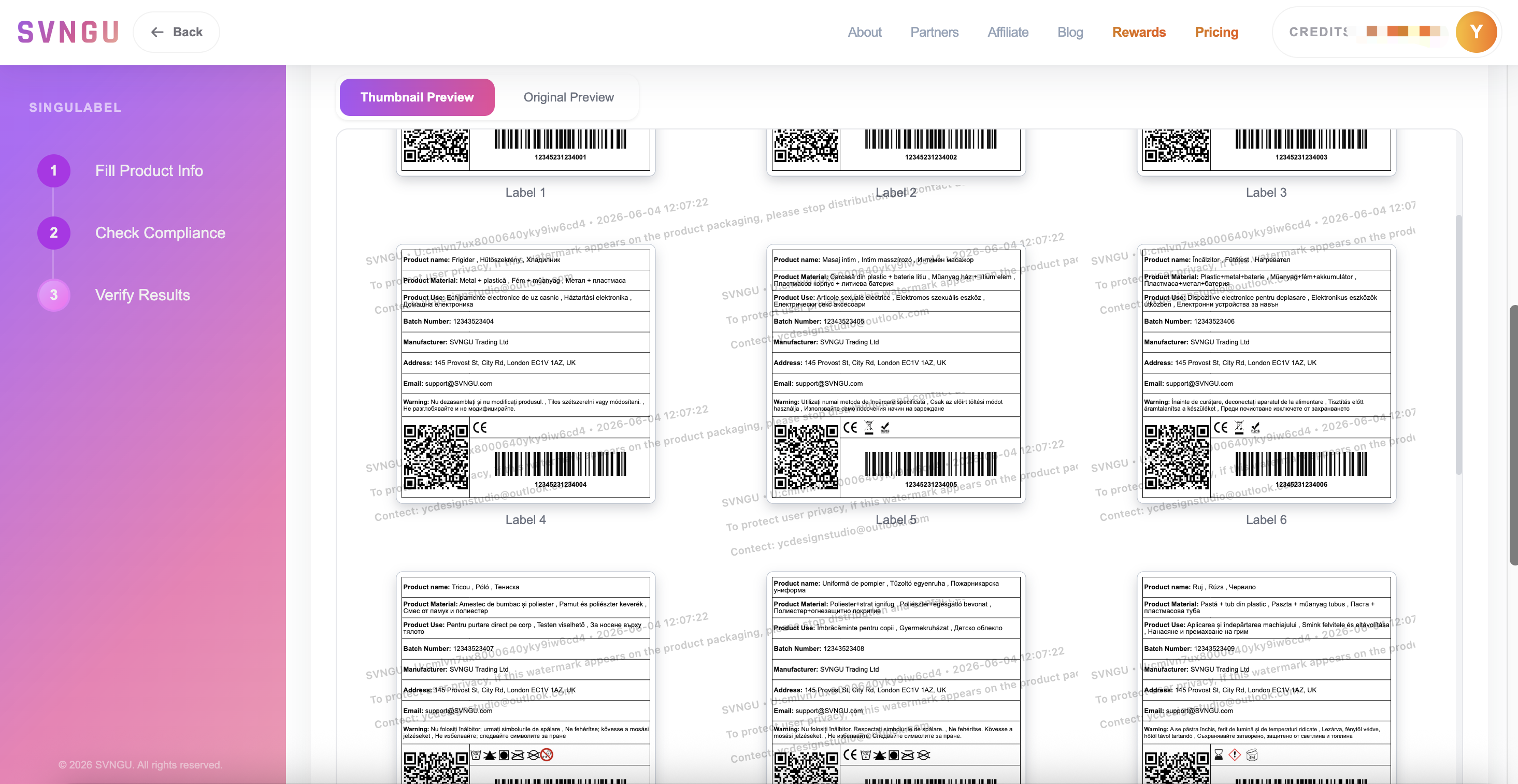
Download the generated label. Each label is unique to the product — applicable EU regulations and harmonised standards vary by category, so every output is individually structured.
Scan the QR code to verify
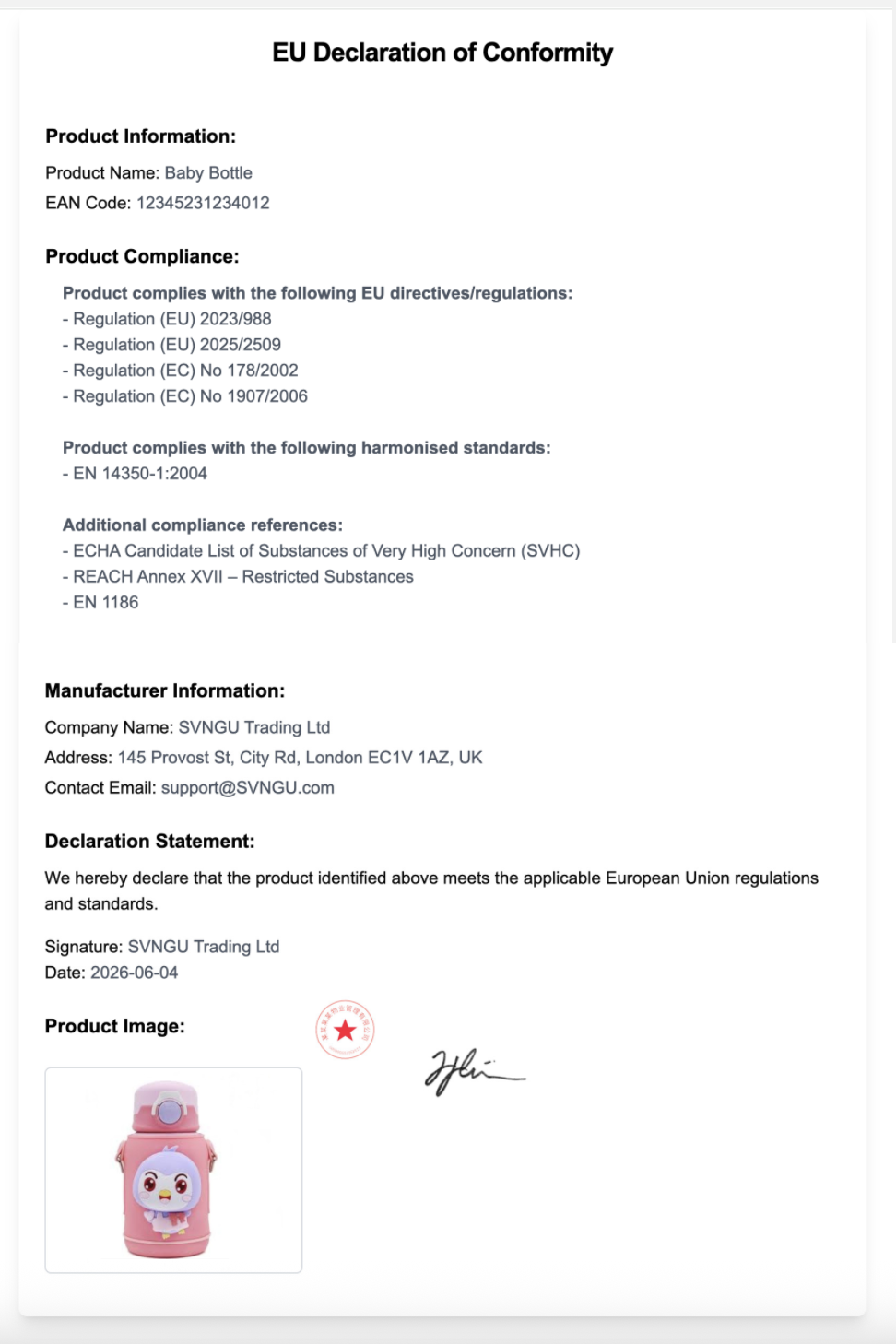
Scan the QR code on the label. The linked page displays the product's compliance information: product details, manufacturer information, creation timestamp, and the manufacturer's signature as required under EU regulations.
What Singulabel Covers
Singulabel is not a generic label builder. Based on product name, purpose, material, target user, and category, it references EUR-Lex, the OJEU, and relevant EU harmonised standards to generate more targeted compliance content for each product.
The system helps sellers identify and organize potentially applicable regulations and standards — including GPSR, REACH, CLP, PPWR, LVD, EMC, RED, RoHS, WEEE, battery regulations, toy safety, PPE, MDR, cosmetics regulations, energy labeling, ESPR, machinery regulations, textile labeling, food safety, and related EN harmonised standards.
Summary
For eMAG sellers, the challenge of GPSR labeling is not just placing a company name and address on a sticker. It is maintaining accurate, clear, and traceable label information across multiple SKUs, product categories, and language requirements — consistently.
Singulabel by SVNGU is designed around this need: bringing product information, manufacturer details, responsible person data, safety notices, barcodes, QR codes, and multilingual content into a single, repeatable label generation workflow.
If you have encountered issues with generic label tools — missing fields, no batch generation, separate QR and barcode handling, or labels not structured for GPSR — try SVNGU's AI label tool at svngu.com. New users can access a free trial.
References
- Regulation (EU) 2023/988 of the European Parliament and of the Council (General Product Safety Regulation). EUR-Lex
- eMAG Marketplace — Legal Requirements and GPSR Data Guide. eMAG Info Center
- EUR-Lex — Access to European Union Law. eur-lex.europa.eu